

Filter Press Plates
Zhengzhou Loreek Machinery Equipment Co.,Ltd. is the professional manufacturer and service provider of filtration and separation equipment. Global service since 2012, Zhengzhou Loreek has supplied products and service to over 30 countries and areas excluding China mainland,Southeast Asia, West Asia, South Asia, Northeast Asia, Middle East, Europe, North America, South America , Africa, Oceania and so on. LOREEK Brand has been one excellent option in this industry.
Why Choose Us
Our Factory
Our Core Team has over 30 years production and manufacturing experience in industrial filtration and separation equipment industry. Now we have two production bases located in central China area. Batch production and Integrated services could satisfy all kinds of market needs.
Rich Experience
Our Core Team has over 30 years production and manufacturing experience in industrial filtration and separation equipment industry. Now we have two production bases located in central China area. Batch production and Integrated services could satisfy all kinds of market needs.
Our Certificate
Up to now, our company has passed BV Approval. And our products has obtained EU CE, and PED certificates.Excellent products is our brand; Attentive service is our work; Professional technique is our core. Loreek Products is your excellent Option.
Professional Team
Zhengzhou Loreek Machinery Equipment Co.,Ltd. is the professional manufacturer and service provider of filtration and separation equipment.

The filter cloth of filter press can intercept the bleaching clay and impurities in the oil and form filter cake under the clamping pressure.

Marble Wastewater Filter Press
Loreek brand marble wastewater filter press is used for removing the impurities in the marble waste water.
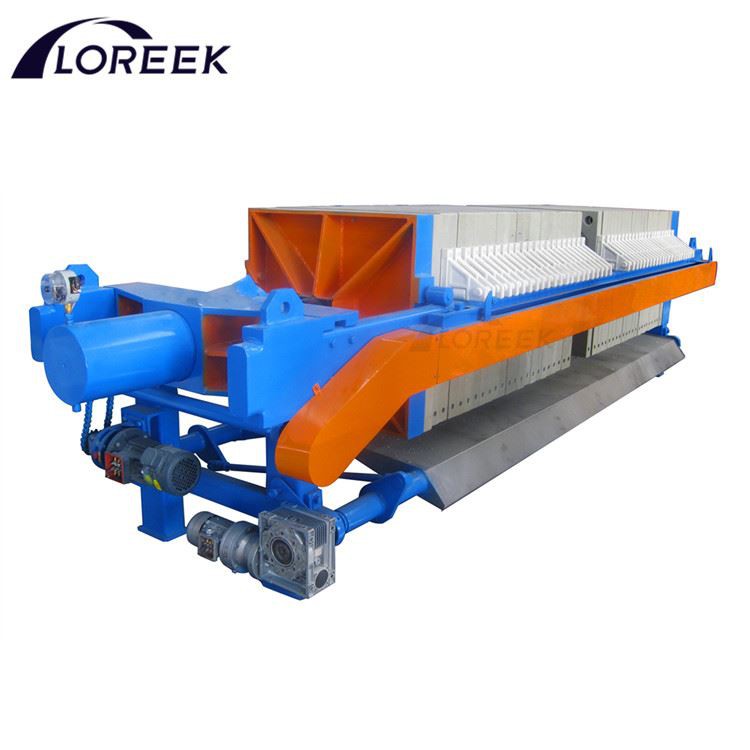
Loreek plate and frame filter press equipment is one kind of traditional solid-liquid separation equipment. Its filter chamber is formed by one plate and one frame.

Tailing Dewatering Press Filter
Our tailing dewatering filter press is a kind of dewatering equipment developed by digesting and absorbing foreign technology.

Mechanical Solid Liquid Separators
Mechanical solid liquid separators is mainly composed of control cabinet, pipeline, body, screen, extruding auger, reduction motor, counterweight, unloading device and other parts.

The sugar syrup filter press uses diatomite and paperboard (or filter cloth) as filter media to filter syrup, carbonated drinks and other liquids with decolorization by activated carbon adsorption.

Loreek sludge treatment filter press is used for sludge dewatering treatment.It mainly consist of frame, filter plate, pressing system and electric control cabinet.

The slurry materials are sent to filter chamber by the pressure of feeding pump and then go into filtrating media (filter cloth) to separate solid and liquid in slurry material.

Palm Kernel Oil Filter Machine
LOREEK Palm Kernel Oil Filter Press Machine are widely used to filter crude kernel oil and crude copra oil extracted from the oil seed expellers to remove impurity and sludge content.
A filter press plate is a component of a filter press machine used in solid-liquid separation processes. Filter plates are typically made of a variety of materials such as polypropylene, stainless steel, cast iron, or aluminum. They come in different shapes and sizes depending on the application and filtration requirements.
Filter press plates are designed to provide a stable and flat surface for the filter cloth, which is used to capture solids during the filtration process. They are arranged in a series, with each plate separated by a frame or spacer. The feed slurry is pumped into the press, and the solids are captured by the filter cloth while the filtrate passes through the plates and is collected in a discharge manifold.
Benefits of Filter Press Plates
Filter Cloth Compatibility:
Designed to securely hold filter cloths, which are essential for trapping solids and allowing liquids to pass through during the filtration process.
Versatility:
Suitable for a wide range of industries including mining, chemical processing, food production, and wastewater treatment.
Environmental Resistance:
Resistant to corrosion and degradation from exposure to chemicals, moisture, and extreme temperatures, ensuring reliability in diverse conditions.
Automation Readiness:
Often part of fully or semi-automated systems, designed with features that facilitate automatic operation, such as plate shifting mechanisms.
Safety Features:
Include pressure release valves and safety interlocks to prevent overpressure and ensure operator safety during operation.
Type of Filter Press Plates
Recessed chamber plates have a higher capacity for solids compared to other types of plates, which makes them ideal for applications that require a high level of solid retention. They are also easy to clean and maintain.
Membrane plates can create a higher pressure differential, which can result in drier cakes and better solid-liquid separation. They are also more efficient at removing solids than other types of plates.
Plate and frame plates are less expensive than other types of plates, and they are versatile and can be used for a variety of applications. They also have a shorter cycle time than recessed chamber plates.
Gasketed plates are easy to assemble and disassemble, which makes them ideal for applications that require frequent cleaning and maintenance. They are also less expensive than other types of plates.
Center feed plates have a high capacity for solids, which makes them ideal for applications that require a high level of solid retention. They are also easy to clean and maintain.
Materials of Filter Press Plates
Filter press plates can be made of various materials depending on the application and filtration requirements. Some of the commonly used materials for filter plates are:
Polypropylene
Polypropylene is a thermoplastic polymer that is lightweight, durable, and resistant to chemicals and high temperatures. Polypropylene plates are widely used in the food and beverage industry, as well as in pharmaceutical and chemical processing applications.
Stainless Steel
Stainless steel is a durable and corrosion-resistant metal that is used in filter plates for applications that require high temperatures or acidic environments. Stainless steel plates are commonly used in the oil and gas industry, as well as in chemical and food processing applications.

Cast Iron
Cast iron is a heavy and durable metal that is used in filter plates for applications that require high pressure and temperature. Cast iron plates are commonly used in mining and mineral processing applications.
Aluminum
Aluminum is a lightweight and corrosion-resistant metal that is used in filter press plates for applications that require high strength and durability. Aluminum plates are commonly used in the aerospace industry, as well as in food and beverage processing applications.
How Does A Plate Filter Press Work?
The plate filter press is an industrial machine that is used in various sectors to dehydrate dense fluids and sludge, by separating the solid part from the liquid one.
The filter press works thanks to a series of porous plates, covered with drain fabric. The thick fluid or sludge is pumped between the plates and pressed, so that the liquid part passes through the fabric and the solid part is retained by the plates. At the end of the operation, the latter are opened to allow the unloading of the panel that they have formed.
Thus the filter pressing process works by leading to a volumetric reduction of fluid substances that contain suspended solid particles. This process allows us to obtain very dry sludge. It can be discontinuous (therefore not very productive) and require a lot of assistance, with an impact on labor costs.
In order to optimize the process and improve the work performance of the plate filter press, it is very important to choose the best pumps for the suction and introduction of sludge and dense fluids inside the filter press.
It is also necessary to carry out a preventive treatment of the sludge, which usually takes place by using ferric chloride and aluminum hydrochloride or polyelectrolytes.
How to Use the Filter Press Plate?
Filter press is the system that ensures the separation of solid materials formed due to industrial wastewater treatment plants and other production processes, their regular removal and the separation of solid-liquid by means of cloths. This system is a filtration system. Filter press plates are used in filtration processes.
Filter press plates used for filtration processes reveal the filtration unit where solid-liquid separation is made. Thanks to the filter press system, it is aimed to separate the wastes such as sand and sludge, which are formed in the wastewater treatment systems, from the facilities. The filter press system is also known as a sludge treatment mechanism or a dewatering machine.
Filter presses offer a wide range of uses. Filter presses used in fabrication are also used in the field of environmental engineering.
Filter press plates preferred for filtration processes form the filtration part where solid-liquid separation takes place. Filter press plates complete the solid-liquid separation process both quickly and smoothly, even at high pressures and flow rates.
Filter press plates have undergone many changes. With these changes, it has taken its present form. Filter press plates were known as a system used in the form of full-empty plates in the 1800s.
Cleaning Plates Of The Filter Press Plates
The cleaning of the filter press plates is necessary when the duration of the filtration cycles becomes excessive or the pressure in the initial stage of filtration is too high.
The use of a portable pressure sprayer, fed with cold water, has the advantage of not requiring the removal of the plates from the filter press.
However, it is necessary to be very careful when using this procedure, to prevent the filtering cloths from being damaged. In order to minimize the risk of accidentally cutting them, it is advisable to use a fan jet, staying a few meters from the surface to be cleaned. It is also better not to exceed the spray pressure.
The acid cleaning of the plates is generally performed by using hydrochloridic acid diluted from 3 to 5%, when there is no sludge inside the filter press. This is a particularly practical method when frequent cleaning of the filter press plates is required.
It works by flooding. The plates are closed together, by pressure, through the hydraulic cylinder which is mounted in the fixed head. Then the hydrochloric acid is added. All automatic valves are closed, to allow the acid to act on the filter cloths and free them from encrustations.
After washing, the acid comes out from special drain valves and is returned to the tank from which it was taken or placed in another tank to be refined and reused.
Filter Press Plates And Their Different Variations
Filter cake thicknesses and filter plate thicknesses are freely configurable depending on the application and filtration conditions. The plate formats vary from 400mm x 400mm up to 2000mm x 2000mm with a cake thickness of 15mm up to 50mm and thus allow an optimal adaptation to the filtration tasks. In this context, we offer a variety of inlet types and plate designs with chamber or membrane technology for older as well as newer makes and third-party systems. Depending on the application, the inlet positions are located in the upper corner, in the centre or on the upper side of the filter plate. Filter press plates with membrane technology allow mechanical squeezing of the filter cake after the actual filtration process, which results in a higher dry matter content. These filter press plates are available either with permanently integrated membranes or with replaceable membranes on request.
Chamber filter press plates and membrane filter press plates can also be supplied in gas-tight & drip-tight designs (CGR). Depending on customer requirements, filter press plates can be individually designed and retrofitted to any existing and commissioned filter press. Filter presses from MSE Filter Presses meet the specific requirements of different applications and industries by equipping each filter press with the appropriate filter plates.
Our Factory
Our Core Team has over 30 years production and manufacturing experience in industrial filtration and separation equipment industry. Now we have two production bases located in central China area. Batch production and Integrated services could satisfy all kinds of market needs.


Our Certificate
Up to now, our company has passed BV Approval. And our products has obtained EU CE, and PED certificates.Excellent products is our brand; Attentive service is our work; Professional technique is our core. Loreek Products is your excellent Option.

FAQ
Hot Tags: filter press plates, China filter press plates suppliers, manufacturers, factory, Manure Dewatering Machine, Sugar Syrup Filter Press, Horizontal Pressure Leaf Filter, Vertical Pressure Leaf Filter, Horizontal Plate Hermetic Filter, Palm Kernel Oil Filter Machine
Send Inquiry
