

Dewatering Screen For Sand
Zhengzhou Loreek Machinery Equipment Co.,Ltd. is the professional manufacturer and service provider of filtration and separation equipment. Global service since 2012, Zhengzhou Loreek has supplied products and service to over 30 countries and areas excluding China mainland,Southeast Asia, West Asia, South Asia, Northeast Asia, Middle East, Europe, North America, South America , Africa, Oceania and so on. LOREEK Brand has been one excellent option in this industry.
Why Choose Us
Our Factory
Our Core Team has over 30 years production and manufacturing experience in industrial filtration and separation equipment industry. Now we have two production bases located in central China area. Batch production and Integrated services could satisfy all kinds of market needs.
Rich Experience
Our Core Team has over 30 years production and manufacturing experience in industrial filtration and separation equipment industry. Now we have two production bases located in central China area. Batch production and Integrated services could satisfy all kinds of market needs.
Our Certificate
Up to now, our company has passed BV Approval. And our products has obtained EU CE, and PED certificates.Excellent products is our brand; Attentive service is our work; Professional technique is our core. Loreek Products is your excellent Option.
Professional Team
Zhengzhou Loreek Machinery Equipment Co.,Ltd. is the professional manufacturer and service provider of filtration and separation equipment.

Vibrating Screen Filter Machine
Loreek L Series vibrating screen filter machine is widely used for coarse filtration in solid-liquid separation industry, such as control screening,slurry clarification and primary filtration.

Liquid Slurry Vibrating Screen
The liquid slurry can realize separation under the function of vibration. In general, liquid slurry vibrating screen will be installed with 2 sieves. Surely more decks are also available.

Dewatering vibrating screen adopts dual-motor self-synchronization technology. The motors coordinate with universal eccentric and adjustable amplitude vibrator. When the two motors start to work, the vibrators move reversely at the same time.

It is very popular in sand plant and purchased. Dewatering screen is also called dewatering vibrating screen. It is mainly used for dewatering fine sand in fine sand recovery equipment.
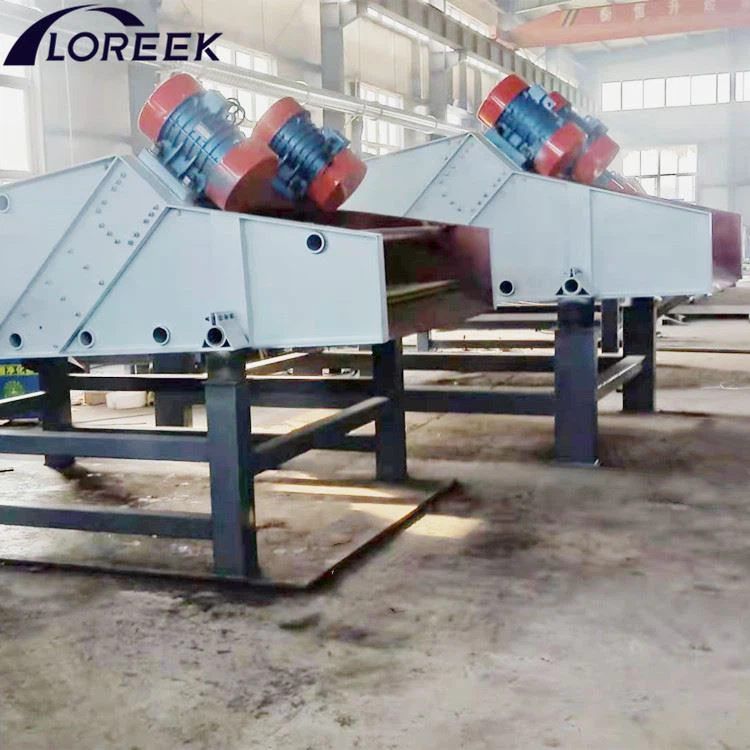
LOREEK LT Series Mining Dewatering screen is mainly used for dewatering, desliming and demedium. It can be used for sand washing in aggregate plant, coal slime recovery in coal preparation plant and tailings dry discharge in concentrator.

The pulp water becomes the material under the screen through the screen, and the fine material is blocked by the screen to form a filter layer, which is moved forward and discharged under the influence of vibration force.

LOREEK LT Series dewatering screen for sand is mainly used for sand washing in aggregate plant or river sand. Therefore, it is also called sand dewatering screen.

Loreek L Series round vibrating screen is also called rotary vibrating sieve,vibratory separator. It can be used for filtering the liquid like waste water, palm oil and crude oil etc.. Our palm oil vibrating screen is used for filtering the crude palm oil.

Round Separators for Screening Fly Larvae
LOREEK Round Separator is one kind of high performance separating equipment which is commonly used to grade wet or dry materials. It can grade materials on up to 6fractions in once operation. The user can choose the sieving fractions based on their separating purposes.
Dewatering screen for sand were first introduced to the mining industry nearly 40 years ago as a more efficient means of dewatering minus 6.35mm solids contained in slurries. In most operations they replaced older technology .
Dewatering screen for sand are simple devices and most often use two counter-rotating vibrating motors (some use twin eccentric shafts) or multiple mechanical exciters on larger machines, which are mounted on a stressed relieved bridge. This drive mechanism is most often combined with an upward inclined deck, usually at three to five degrees.
Benefits of Dewatering Screen For Sand
Drip-free Sand
Using an Dewatering Screen will aid in reducing moisture content of a final product for easier stockpiling and handling or immediate sale. It can lower the moisture content of your material to around 10%, depending on the application. The discharge from the Dewatering Screen is classified as drip-free and can be easily conveyed, placed in a bin or loaded into a truck for easy transportation. A Dewatering Screen is a low-cost solution for feeding dryers, loading conveyors and trucks, or discharging material to other equipment.
Cleaner Stockpiles
Stockpiles from Dewatering screen for sand have less water in them, so they require less drainage consideration. Less water in the stockpiles also means that the product can be moved sooner, which reduces the stockpile footprint as a result. The decreased amount of water draining from the stockpile also minimizes its spread.
Dewatering screen for sand create taller stockpiles with steeper stacking angles, so more product is housed in a smaller footprint. Dewatering screen for sand also allow for better stockpile management with a shorter inventory cycle.
Improved Housekeeping
Dewatering screen for sand produce a drip-free product, which allows for a cleaner operating environment with less conveyor spillage to clean up. Because Dewatering screen for sand remove excess water from the final product, less of a mess is created under the conveyors. With less water in the product, discharge sand doesn't stick to the conveyor belts as readily, so the returning belt is not spilling sand.
Low Maintenance
Because dewatered sand doesn't stick to the conveyor belt as readily, the returning belt does not spill sand underneath the conveyor. This reduces the need for conveyor belt maintenance and limits the use of belt scrapers that remove residual sand stuck to the belt.
How Does a Dewatering Screen For Sand Work?
The Dewatering screen for sand design is relatively simple. The majority of Dewatering screen for sand systems utilize two counter-rotating vibrating motors, while some utilize twin eccentric shafts. At the same time, other types of Dewatering screen for sands employ multiple mechanical exciters on larger machines that are mounted on a stressed relieved bridge. The drive component is typically set up with an inclined deck that may be set anywhere from three to five degrees. Here's how Dewatering screen for sands work to reduce the water content of slurries:
The slurry of water and solids is sent down a declined, steeply screened surface to achieve rapid drainage.
When the slurry passes over the screens, water is drained from the mixture and creates a pool in the valley.vibrate throughout the process to help additional water separate from the solution.
As the slurry moves through the system, it is taken back up an incline. The screens continuously vibrate throughout the process to help additional water separate from the solution.
An uphill slope of the screen surface can be combined with a discharge weir to create a deep bed that functions as a filter medium. This allows for even finer solids to be screened out.
lf you would like an even more refined, cleaner product, you can use a rinsing station along the pathway. The sand dewatering equipment can remove the water used for rinsing just as it separates the water from the slurry.
Type of Dewatering Screen For Sand
Slime Dewatering Screen:
It is specially used for washing equipment for desliming, stripping and dewatering in coal washing plants. It can be used for recovering slime with a particle size of <9mm. It is a special equipment for dewatering operations of coal slime, which is widely used for slime recovery. Pressure filtration and thickening, filtration, and other fine material dehydration, recycling operations.
Sand And Stone Dewatering Screen:
It is commonly used in the wet sand production line and sand washing machine for supporting use, can also be used alone. Sand and gravel are washed by sand washer, then for hydraulic classification, desliming and sand recovery by dewatering screen. To achieve a reasonable particle size ratio, and reduce the mud content below 0.7%.
Tailings Dewatering Screen:
It is widely used in tailings dry discharge, concentrate dewatering and other operations. This equipment is particularly suitable for the treatment of fine-grained minerals, for the automatic separation of slag water, tailings dry discharge technology, etc., can also be used together with the cyclone as a tailings dry discharge recycling machine, high dewatering efficiency.
Choosing the Right Dewatering Screen For Sand
Taking Into Consideration The Nature Of Materials
The elements of solid-liquid morphology, particle size, humidity, viscosity, bulk-specific gravity, and other features are the primary contributors to the properties of materials. The materials have particular features, such as high temperature, corrosion, static electricity, etc., since various materials require different kinds of Dewatering screen for sand or whether the materials have special properties.
Screening Purpose
A straight-line dewatering screen is an option for coarse screening, while the rotary dewatering screen, ultrasonic dewatering screen, and ultrasonic dewatering screen are options for fine screening.
Treatment Capacity
Depending on the demands placed on the capacity of the material handling system, select from among many distinct types of Dewatering screen for sand.
Time Spent at Work
The model, the material, and the technical characteristics of the dewatering screen will all change depending on whether the screen constantly operates for a long time or occasionally.
Application field of Dewatering Screen For Sand
Dewatering screen for sand, also known as vibrating Dewatering screen for sand (high frequency Dewatering screen for sand), changes the water tension on the surface of the slurry through the exciting force. The pulp water passes through the screen and becomes the material under the screen, while the fine material is blocked by the screen to form a filter layer, which is moved forward and discharged under the influence of vibration force.
Dewatering screen for sand is mainly used to separate the slag water of tailings, which is widely used in the treatment of iron ore, gold ore, copper ore, vanadium ore, lead-zinc ore, graphite ore and other tailings.
In the sand washing plant, the sand washed by spiral sand washing machine/screw sand washer, wheel sand washing machine or vibrating screen will be dehydrated to separate water and sand particles, recover water and reduce the water content of finished products.
In the sand washing plant, the combination of Dewatering screen for sand and hydrocyclone can recover fine sand from tailings of sand washing plant, remove soil and obtain valuable fine sand.
The Dewatering screen for sand is suitable for the pretreatment of all kinds of soil, with the characteristics of thorough soil leaching, large treatment capacity, good separation effect of sludge and water, low moisture content of sludge.
In coal washing process, Dewatering screen for sand can separate coal and slurry to obtain clean finished coal.
In the sewage treatment industry, the Dewatering screen for sand can separate the solid-liquid wastewater, remove the waste and large particles from the sewage, and then filter the fine materials.
How To Ensure Uniform Discharge Of Materials On The Dewatering Screen For Sand?
Influence Of Support Spring On Vibrating Screening: If the stiffness of the support spring of the vibrating screen is inconsistent during screening, it will lead to the imbalance of the support of the screen machine. This requires the user to check before startup to ensure that each position is consistent before starting the equipment;
Poor Rigidity Of Screen Frame: The screen frame needs to be compressed during installation. Uneven stress or poor stiffness of the screen frame during screening will lead to material deviation. The motion of the screen body is torsional rather than translational. The Dewatering screen for sand with strong rigidity shall be selected for production during screening.
The Excitation Force On Both Sides Of The Screen Is Uneven, Resulting In Different Amplitudes On Both Sides: In view of this situation, it is necessary to timely adjust the eccentric block of the vibration motor to make the motor amplitude the same.
Uneven Feeding On The Production Site: In the use of dehydration screen, ensure uniform feeding, so as to effectively avoid the faults in the production and use of dehydration screen.
How To Improve The Dewatering Effect Of Dewatering Screen For Sand?
The Dewatering screen for sand uses the vibration motor as the excitation source, so as to obtain high-frequency vibration, and to produce high-efficiency dewatering effect. The volume of the Dewatering screen for sand is small, the noise is low, and it will not cause any pollution to the environment.
THe Influence Of Material Particle Shape On Dewatering Effect Of Dewatering Screen For Sand.
There are many shapes of material particles to be dehydrated, such as spherical, cubic, polygonal, flat row, flaky and so on. According to SINONINE's experience for many years, there are enough voids between spherical, cubic and polygonal material particles, which can be easily dehydrated. The dewatering efficiency will be more than 50% higher than that of flat and flaky material particles. The settlement resistance of flat and flaky material particles is large, which is not conducive to dehydration.
The Effect Of Particle Size And Its Characteristics On The Dewatering Effect Of The Dewatering Screen For Sand.
The particle size distribution of the material also has a great influence on the dewatering effect of the Dewatering screen for sand, and the proportion of the fine material has a great influence on the dewatering effect. The screen mesh size should be matched according to the average particle size of the material to keep a certain proportion of particles larger than the average particle size, so as to improve the dehydration effect.
The Influence Of Material Density On Dewatering Effect Of Dewatering Screen For Sand.
If the density difference between solid and liquid is small, the possibility of solid particles losing with liquid will increase in the dewatering process. At this time, the flow rate of materials should be slowed down, the residence time of materials on the screen should be prolonged, and the inclination angle of the Dewatering screen for sand should be increased.
The Influence Of Material Composition On Dewatering Effect Of Dewatering Screen For Sand
If the content of clay material is large, the slurry viscosity will increase, which is not conducive to dewatering. A single material has a single material layer structure than a variety of composite materials, and the dewatering effect is better and faster than a variety of composite materials.
How To Maintain The Dewatering Screen For Sand
Dewatering screen for sand should pay attention to some inspection and maintenance when it is used at ordinary times. The most basic inspection is to see whether the coarse mesh part and the fine mesh part are damaged.
There will be rings on the screen. If these rings are not locked, they must be locked first and then applied to the equipment. In addition to these conditions, check whether other parts are damaged. For example, there are some circular vibrating screens with v-rings on them. If the parts are damaged, they should be repaired.
The reason to check whether these nets are damaged is because if there is damage, it will lead to material leakage. At this time, it will be very troublesome to rearrange the materials, which will also affect the eating and difficulty of materials. In addition to these, it is necessary to check whether there is noise when starting the equipment. If so, it indicates that some parts on the vibrating screen have problems. Then, check whether there is any problem with the current, such as whether it is stable.
In the process of use, we should know whether the vibration of the whole equipment is abnormal. In a word, if there are some problems in the vibrating screen itself during startup, these faults should be eliminated before restart. After use, you should also pay attention to clean up these things, not the next time you use them. In addition, when not in use, the equipment should be maintained as much as possible to ensure that the vibrating screen can be used for a long time.
Our Factory
Our Core Team has over 30 years production and manufacturing experience in industrial filtration and separation equipment industry. Now we have two production bases located in central China area. Batch production and Integrated services could satisfy all kinds of market needs.


Our Certificate
Up to now, our company has passed BV Approval. And our products has obtained EU CE, and PED certificates.Excellent products is our brand; Attentive service is our work; Professional technique is our core. Loreek Products is your excellent Option.

FAQ
Hot Tags: dewatering screen for sand, China dewatering screen for sand suppliers, manufacturers, factory, Palm Kernel Oil Filter Machine, Horizontal Plate Hermetic Filter, Pressure Leaf Filter for Chemical Industry, Sulphur Filtration Horizontal Pressure Leaf Filter, Vertical Pressure Leaf Filter, Dewaxing Horizontal Pressure Leaf Filter
Send Inquiry
